Model Metrics
Notice: Model metrics are enabled only when the execution pipeline is in the Running status and at the Training stage.
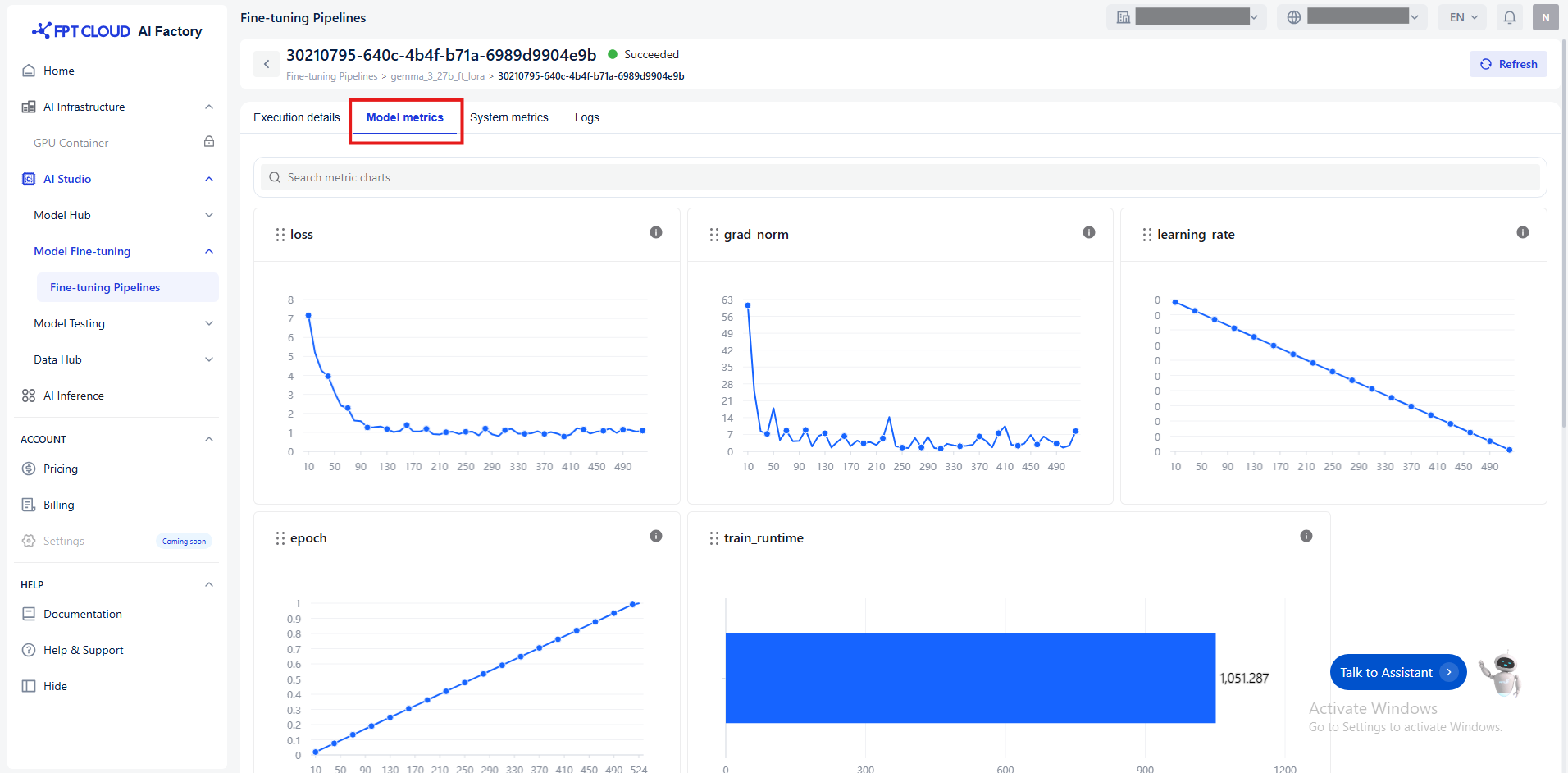
Model metrics are collected to track the training performance of AI models during and after the fine-tuning process. These metrics help detect training anomalies, guide hyperparameter adjustments and improve model performance. Training metrics:
| Metric | What it evaluates |
|---|---|
| loss | Measures how well the model is learning. A high loss means poor prediction; a low loss means the model is fitting the data well. |
| learning_rate | Controls how fast the model learns. A learning rate that’s too high can cause instability; too low can slow down training. |
| grad_norms | Indicates the magnitude of gradients. Helps detect issues like vanishing or exploding gradients, which affect learning. |
| epoch | Tracks how many full passes the model has made over the training data. Useful for monitoring learning progress over time. |
| Evaluation metrics: | |
| Notice: Only shown when evaluation data is used. | |
| Metric | What it evaluates |
| --- | --- |
| eval_runtime | Measures how long the evaluation process takes. Useful for performance benchmarking. |
| eval_samples_per_second | Indicates evaluation throughput. Higher is better for faster model validation. |
| eval_steps_per_second | Measures how many evaluation steps are completed per second. Reflects evaluation efficiency. |
| eval_loss | Measures how well the model generalizes to unseen data. Helps detect overfitting or underfitting. |
| Training performance metrics: | |
| Metric | What it evaluates |
| --- | --- |
| train_runtime | Total time spent training. Useful for estimating training cost and efficiency. |
| train_samples_per_second | Measures training throughput. Higher values indicate faster training. |
| train_steps_per_second | Indicates how many training steps are completed per second. Reflects training speed. |
| total_flos | Total floating point operations used. Helps estimate computational cost and model complexity. |
| train_loss | Measures how well the model fits the training data. Should decrease over time if training is effective. |