SSO via Legacy FCDClient
Access via Legacy FCDClient (Legacy Flow)
For users currently using the previously installed legacy FCDClient.
Note:
- Access via the legacy FCDClient on PC or laptop will be discontinued after March 31, 2026. Access via other devices will continue to be supported until further notice. Users should proactively install the new FCDClient to avoid workflow interruption.
- The access procedure via the legacy flow is similar to the Web Browser Access Guide, with the only difference being that at the virtual machine selection step, users choose the FCDClient access method.
1. Access the Service Homepage with the appropriate URL
Valid URL formats:
- The enterprise/organization's dedicated URL for FCD (provided by the customer administrator to users)
- A URL already containing a valid authentication code (format: code.domain). Example: pil783454741.pilotfcd.online
- The service's default URL
This URL information is provided by the customer administrator.
Access the service link via a web browser and select Access through FPT Cloud Desktop Client.
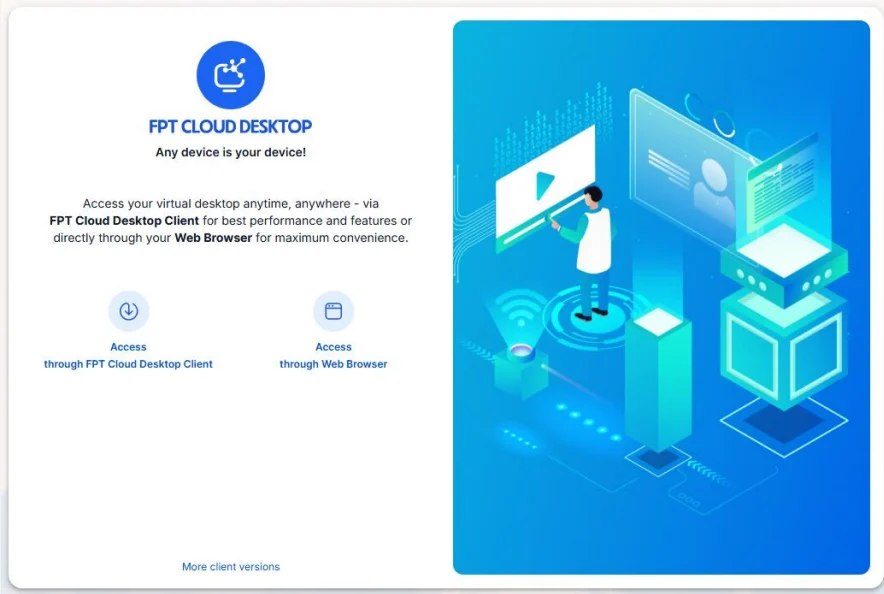
2. Log in to the appropriate Authenticator (Server)
If the user accesses via a URL already containing a valid authentication code (e.g., URL with valid code: pil783454741.pilotfcd.online):
- Simply log in with the corresponding SSO account (e.g., log in with a Microsoft account), enter the corresponding OTP for SSO => Authenticator (Server) login successful.

If the user downloads the Client from the service's default URL:
- Enter the Authentication Code information (managed by the customer administrator) (Example of valid Authentication Code: pil783454741)
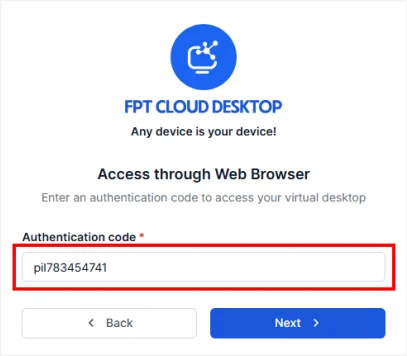
- Log in with the corresponding SSO account (e.g., log in with a Microsoft account), enter the corresponding OTP for SSO => Authenticator (Server) login successful.
3. Access the virtual machine. On the virtual machine list screen, select the desired virtual machine to access. Note: At this step, users select the FCDClient access option.
- If the user has the legacy FCDClient installed: The system will open the legacy FCDClient to access the virtual machine. Enter the login credentials for the virtual machine if prompted by the system => Virtual machine access successful.
-
* If the user has the new FCDClient installed: The system will prioritize opening FCDClient. Users need to repeat the access steps similar to [Step 2: Access virtual machine via new FCDClient](<https://fptcloud.com/documents/fpt-cloud-desktop/?doc=SSO-qua-FCDClient-moi#contentify_1> "Step 2: Access virtual machine via new FCDClient").

- Enter the account credentials corresponding to the Server you want to log in to.
Note: If a two-factor authentication QR code is displayed: Download and install the Microsoft Authenticator app on your phone from the Apple Store or CH Play/Google Play.
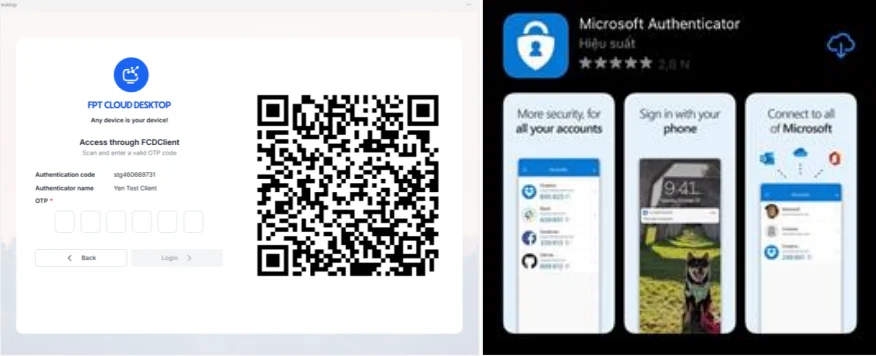
Open the Authenticator app and scan the QR Code.

- The app will synchronize and display the OTP to log in to FCD.
- Enter the OTP and click Submit => Authenticator (Server) login successful.
3. Access the virtual machine
On the virtual machine list screen, select the desired virtual machine to access.
Note: At this step, users select the FCDClient access option.
- If the user has the legacy FCDClient installed: The system will open the legacy FCDClient to access the virtual machine. Enter the login credentials for the virtual machine if prompted by the system => Virtual machine access successful.
- If the user has the new FCDClient installed: The system will prioritize opening FCDClient. Users need to repeat the access steps similar to Step 2: Access virtual machine via new FCDClient.
